Black Sea naval war escalates as attacks on ships and ports threaten global grain supplies
Ukrainian and Russian attacks on civilian ships and ports in the Black Sea have sharply escalated, disrupting trade and raising fears that the grain corridor's collapse could trigger a new global food crisis.
The Black Sea naval war escalated sharply in July 2026, with Ukrainian and Russian attacks targeting civilian ships and port facilities. The strikes have severely disrupted regional sea trade, and analysts warn that a collapse of the grain corridor could trigger a new global food shortage.
Attacks on civilian ships and port facilities have sharply escalated the naval war between Russia and Ukraine in the Black Sea and the Sea of Azov, according to reports dated 25 July 2026. Both sides are now striking commercial vessels, with dozens of ships reportedly hit within weeks, including Russian oil tankers and other freighters. The Black Sea, bordered by Russia, Ukraine, Turkey, Bulgaria, Romania and Georgia, is one of the world's most important corridors for grain exports. Its only outlet to the Mediterranean runs through the Bosporus and the Dardanelles, making every ship passing through vulnerable to the conflict. Ukraine and Russia have both expanded their operations at sea, reports suggest, and Moscow is now responding with attacks of its own on shipping. The escalation matters far beyond the region. An analysis by Foreign Policy warns that the attacks could trigger a renewed global food shortage by disrupting the grain trade. Reports also indicate that Russian grain exports are at risk of falling to their lowest level in ten years, raising the stakes for importing countries worldwide.
Attacks on ships and ports push the Black Sea back to the centre of the war
The naval war in the Sea of Azov and the Black Sea has intensified sharply, according to reports dated 25 July 2026. Ukrainian and Russian forces are now directing attacks at civilian ships and port installations, a shift that has pushed the region's commercial shipping lanes back to the centre of the conflict.
The impact on maritime trade has been severe. According to the reporting outlets, dozens of vessels were struck within the space of a few weeks, among them Russian oil tankers and other freighters. Moscow, which had previously concentrated on port infrastructure, is now reported to be attacking ships at sea in its own right. Ukraine, for its part, has expanded its campaign against Russian-linked shipping and coastal targets.
The escalation carries stakes well beyond the region. The Black Sea is one of the world's most important corridors for grain exports, and an analysis by Foreign Policy warns that attacks on ports and ships there could trigger a renewed global food shortage. Whether the fighting will actually choke off the grain trade is the question now hanging over the conflict; the reports raise it without yet answering it.
Much of the picture rests on claims from the warring parties and on reporting that could not be independently confirmed. Moscow has asserted, for example, that at least one vessel it struck was carrying military goods rather than civilian cargo. What is clear is that both sides are widening their operations at sea, and that the commercial traffic on which the region's exports depend is caught between them.
Burning freighters and a damaged German ship: the incidents so far
Among the most striking incidents reported in recent weeks is the attack on the German freighter Emil. According to the reports, Russian drones severely damaged the vessel off Odessa. A fire broke out on board, several technical systems failed, and the ship was left unmanoeuvrable.
The Emil was far from the only vessel affected. Reports say dozens of ships were hit in the Black Sea within the space of a few weeks, among them Russian oil tankers and other freighters. Moscow, according to these accounts, has itself begun striking ships in the Black Sea in response to earlier attacks.
One of the deadliest reported incidents involved a freighter carrying Ukrainian wheat, which caught fire after a Russian attack in the Black Sea. One person was killed and three others were injured, the reports say. Moscow has claimed that the vessel was transporting military goods — a claim that, like the other details, could not be independently verified.
Odessa itself has again come under fire, according to the reports, with the port city targeted by renewed missile and drone strikes. The attacks on the city and on shipping in its waters underscore how directly the fighting now touches one of Ukraine's most important outlets to the sea.
Taken together, the reported incidents point to a conflict in which commercial shipping has become a regular target rather than collateral damage. Freighters under various flags, tankers and grain carriers alike have been caught up in the strikes. The precise timing of most of these attacks remains unclear; only the escalation reported on 25 July 2026 is firmly dated. Casualty figures beyond the wheat freighter attack have not been reported.
From Gelendzhik to the beaches: the war reaches symbolic targets
The war at sea has also struck targets far from the shipping lanes. According to reports, Ukrainian drones hit a Russian air-defence position near Gelendzhik on the Black Sea coast — a site said to protect a palace linked to President Vladimir Putin. The installation struck reportedly lay around 19 kilometres from the estate. The claim has not been independently confirmed and should be treated with caution.
A second incident, also based on unverified reporting, points to the human cost away from the front line. Russian air defences are said to have shot down a drone over a crowded bathing beach, killing six people. A video verified through open-source analysis reportedly shows the moment of impact on the beach.
Neither Moscow nor Kyiv has publicly addressed the two incidents in detail, and the circumstances remain murky. But if the reports hold, they mark a notable expansion of the conflict's geography: from the ports and grain routes to a presidential residence on the coast and a stretch of shoreline filled with civilians. The symbolic weight of both targets — one associated with Putin personally, the other with ordinary holidaymakers — underscores how far the maritime war has spread beyond its original military logic.
Why grain exports are at the heart of the alarm
The concern now extends well beyond the immediate fighting. An analysis by Foreign Policy warns that attacks on ports and ships in the Black Sea could trigger a renewed global food shortage, reviving fears that accompanied the early phase of the war, when grain shipments from the region were first disrupted.
Both Russia and Ukraine are among the world's major grain exporters, and much of that trade moves through Black Sea ports. When freighters cannot sail safely, the consequences are felt far beyond the region, particularly in countries that depend on imported wheat.
Reports suggest the pressure is already visible in trade figures. According to these accounts, attacks on commercial vessels in the Black Sea have contributed to a decline in Russian grain exports, which are said to be at risk of falling to their lowest level in ten years. These figures are attributed claims rather than confirmed data, and the precise impact on global markets remains unclear.
The same caution applies to the broader warnings. A worldwide food shortage has not materialised; what exists is an analysis pointing to that risk if the attacks on shipping and port infrastructure continue. Whether the corridor can be kept open, and at what cost to the vessels using it, will determine how much of that warning becomes reality.
A confined sea with one narrow exit: the geography shaping the conflict
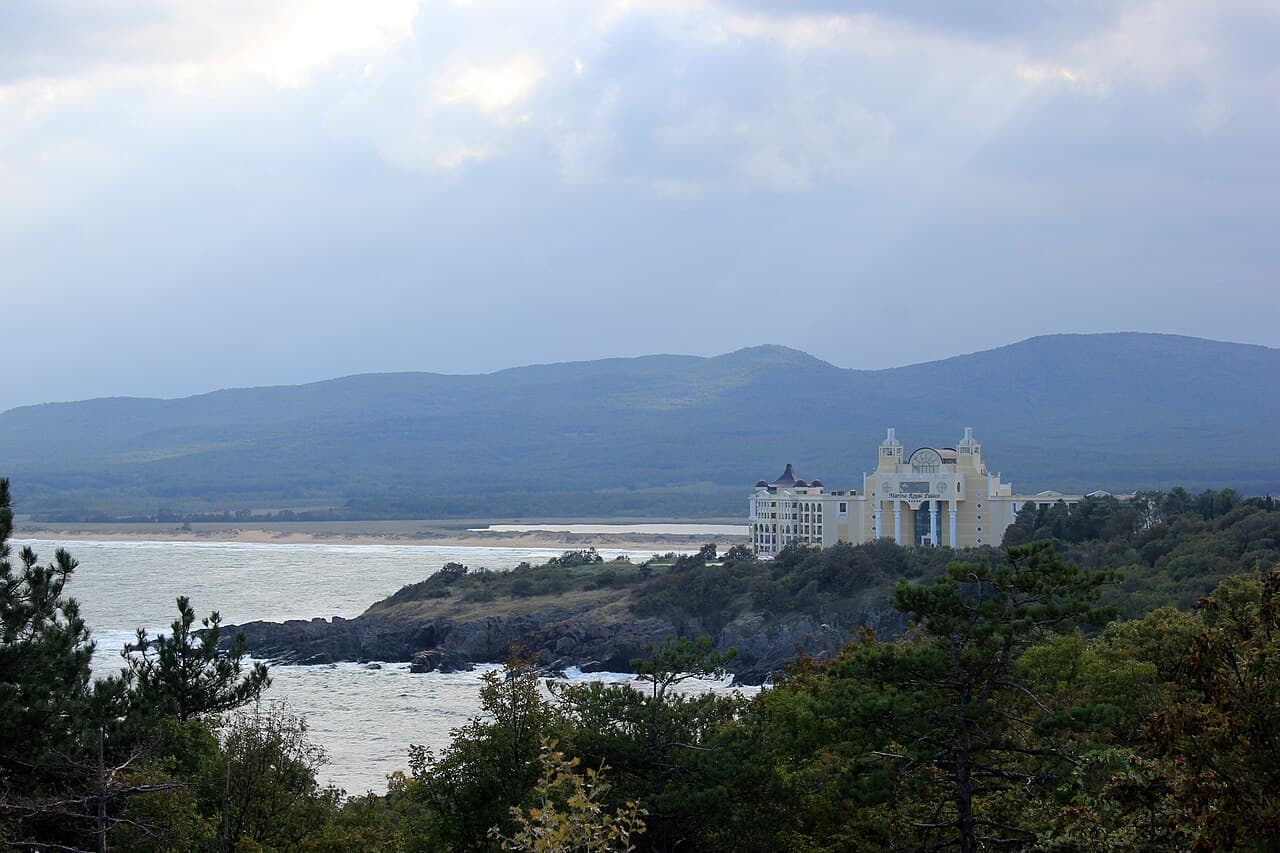
The Black Sea is an inland sea lying between southeastern Europe, eastern Europe and western Asia. Six countries share its coastline: Bulgaria, Georgia, Romania, Russia, Turkey and Ukraine. That geography alone explains why any conflict along its shores draws in so many actors at once.
The sea covers roughly 436,400 square kilometres and holds about 547,000 cubic kilometres of water. Its maximum depth reaches 2,212 metres, with an average depth of 1,253 metres. Three of Europe's great rivers, the Danube, the Dnieper and the Dniester, drain into it, linking its ports to a vast agricultural and industrial hinterland.
What makes the Black Sea strategically decisive, however, is its single outlet. It connects to the eastern Mediterranean only through the Bosporus and the Dardanelles, two narrow straits both controlled by Turkey. Every cargo of grain, oil or goods leaving the region by sea must pass through this corridor. There is no alternative route for bulk shipping.
That bottleneck means disruption anywhere in the basin quickly becomes a global concern. When ports and shipping lanes come under attack, the effects travel straight through the straits and onto world markets — and they hand the guardian of the straits considerable leverage over both belligerents.
Turkey demands a moratorium and seeks a pivotal role
Turkey has called on both Russia and Ukraine to halt their attacks in the Black Sea and has spoken out in favour of a moratorium, according to reports. Ankara is the only Black Sea littoral state with direct leverage over the waterway's sole exit, and analysts cited in the coverage suggest that the spread of drone warfare has handed Turkey a newly pivotal role in the region. The argument is that as strikes on shipping multiply, whoever can influence access through the Bosporus gains weight with both belligerents.
How much influence Ankara actually wields remains unclear. Neither Moscow nor Kyiv has publicly responded to the Turkish demand, and it is not known what concrete steps, if any, Turkey is prepared to take to enforce or broker a pause in the attacks. For now, the moratorium proposal stands as a diplomatic appeal rather than an agreed measure.
A widening maritime conflict with open questions
The fighting is no longer confined to the Black Sea. Ukraine carried out a deadly attack on an Iranian ship in the Caspian Sea, after which threats between the parties escalated. According to reports, Russia and Ukraine have been expanding their operations against each other at sea, raising the prospect of a wider maritime conflict.
Much remains unclear. Beyond the escalation reported on 25 July 2026, the exact dates of most attacks are not established, and casualty tolls for the strikes on ships and ports are unknown. The impact of falling Russian grain exports on global markets has yet to be measured. And the warning of a worldwide food shortage remains precisely that — a warning, issued by Foreign Policy, not a confirmed reality. How far the conflict spreads, and what it costs, are open questions.
Frequently asked questions
What is happening in the Black Sea right now?
According to reports from 25 July 2026, the naval war in the Sea of Azov and the Black Sea has intensified, with Ukrainian and Russian attacks targeting civilian ships and port facilities. The attacks are significantly disrupting maritime trade in the region. Reports say dozens of vessels were hit within a few weeks, including Russian oil tankers and other freighters.
Could the Black Sea attacks cause a global food crisis?
An analysis by Foreign Policy warns that attacks on ports and ships in the Black Sea could trigger a renewed global food shortage. The reports raise the question of whether the naval war threatens the grain trade. According to some reports, attacks on commercial vessels have contributed to a decline in Russian grain exports, which are said to be at risk of falling to their lowest level in ten years.
Was the German cargo ship Emil attacked near Odessa?
According to reports, Russian drones severely damaged the German freighter Emil off Odessa. A fire broke out on board, several technical systems failed, and the ship was left unable to manoeuvre. The port city of Odessa itself was reportedly attacked again with missiles and drones around the same period.
What role is Turkey playing in the Black Sea conflict?
According to reports, Turkey has called on Russia and Ukraine to halt their attacks in the Black Sea and has spoken out in favour of a moratorium. Reports also suggest that drone warfare now threatens the wider Black Sea region and has given Turkey a new pivotal role. How Moscow and Kyiv responded to the Turkish demand is not yet known.
Where is the Black Sea and which countries border it?
The Black Sea is an inland sea between southeastern Europe, eastern Europe, and western Asia, bordered by Bulgaria, Georgia, Romania, Russia, Turkey, and Ukraine. It connects to the eastern Mediterranean via the Bosporus and the Dardanelles. It covers roughly 436,400 square kilometres, has a maximum depth of 2,212 metres, an average depth of 1,253 metres, and a volume of about 547,000 cubic kilometres.