U.S.-U.K. Diego Garcia Base Remains Central Amid Sovereignty Shift and Iranian Tensions
The treaty transferring sovereignty over the Chagos Islands to Mauritius preserves the U.S.-U.K. military base at Diego Garcia, while recent Iranian missile launches and shifting U.S. logistics have intensified regional scrutiny.
The treaty transferring sovereignty over the Chagos Islands to Mauritius preserves the U.S.-U.K. military base at Diego Garcia, ensuring its continued operation despite the sovereignty shift, while recent Iranian missile launches and U.S. Navy logistics adjustments have heightened regional tensions.
The treaty signed on 22 May 2025 transfers sovereignty over the Chagos Islands from the United Kingdom to Mauritius, but it includes a clause that guarantees the continued operation of the U.S.–U.K. military base at Diego Garcia. Diego Garcia is the largest island of the Chagos Archipelago and has hosted a joint British and American installation since the 1970s. The base, known as Naval Support Facility Diego Garcia, supports U.S. carrier strike groups and logistics for the Gulf and Indian Ocean regions. The agreement preserves the strategic hub at a time when Iran has fired ballistic missiles toward the installation and issued warnings to the United Kingdom over its cooperation with U.S. forces, underscoring the base’s heightened geopolitical significance.
Diego Garcia's Role as a Strategic Logistics Hub
Diego Garcia functions as the principal U.S. Navy logistics hub in the Indian Ocean. The island hosts the Naval Support Facility, a British Indian Ocean Territory base jointly used by the Royal Navy and the United States Navy. Its deep-water anchorage and airfield enable rapid resupply of carrier strike groups operating across the region. After Iranian missile strikes damaged a key American logistics node in Bahrain, Pentagon planners redirected the primary regional resupply chain to Diego Garcia. The shift reduced dependence on Bahraini facilities and restored a critical node for fuel, ammunition and food deliveries to ships transiting the Gulf of Oman and the Arabian Sea. U.S. officials say the new hub shortens transit times and increases operational flexibility. B-2 stealth bombers have recently arrived on the island, underscoring its growing strategic importance. The base supports both U.S. and U.K. carrier groups and serves as a forward staging point for air and naval assets. Because of its location equidistant from the Middle East, India and Southeast Asia, Diego Garcia allows quicker response times than alternatives in the Pacific or Europe. The continued operation of the hub is guaranteed by a treaty signed on 22 May 2025 that transferred sovereignty over the Chagos Islands from the United Kingdom to Mauritius while preserving the military presence. That clause ensures that the logistical network remains intact despite the sovereignty change. The base’s role now centres on maintaining supply lines for U.S. naval forces in a contested maritime environment. Its resilience reflects decades of joint planning and ongoing investment in infrastructure. As Iran issues repeated warnings over the use of British bases for offensive operations, Diego Garcia stands as a focal point of both military planning and diplomatic tension. The island’s strategic value continues to grow as regional threats evolve and logistics demands increase.
Diego Garcia has been used as a joint UK–U.S. military base
A treaty to transfer sovereignty from the UK to Mauritius was signed, with a provision that the military base at Diego Garcia would continue to operate
The treaty includes a provision ensuring the continued operation of the military base at Diego Garcia
The treaty to transfer sovereignty from the UK to Mauritius was signed, preserving the U.S.-U.K. military base at Diego Garcia
The treaty signed on 22 May 2025 includes a clause maintaining the military base at Diego Garcia despite sovereignty transfer
The treaty transferring sovereignty over the Chagos Islands to Mauritius was signed, with an agreement that the U.S.-U.K. military base at Diego Garcia would remain operational
The treaty signed on 22 May 2025 stipulates that the U.S. and U.K. military presence at Diego Garcia will continue
The treaty signed on 22 May 2025 includes a provision for the continued use of Diego Garcia by U.S. and U.K. forces
The treaty signed on 22 May 2025 between the UK and Mauritius provides for the continued operation of the military base at Diego Garcia
The treaty signed on 22 May 2025 includes language preserving the U.S. and U.K. military presence at Diego Garcia
The treaty signed on 22 May 2025 includes a clause ensuring the military base at Diego Garcia remains operational
The treaty signed on 22 May 2025 includes a provision that the U.S. and U.K. military base at Diego Garcia will continue to operate
Sovereignty Transfer and the Base Continuity Clause
The treaty signed on 22 May 2025 transfers sovereignty over the Chagos Islands to Mauritius but includes a provision ensuring the continued operation of the U.S.-U.K. military base at Diego Garcia. The agreement preserves the existing security arrangements that have shaped the base’s role since the 1970s, confirming that American and British forces will retain access to the atoll for an indefinite period. This clause effectively decouples the transfer of territorial sovereignty from the operational status of the logistics hub, allowing the Pentagon to maintain its forward-deployed supply chain without interruption.
The base’s significance has grown in recent weeks after Iran launched ballistic missiles at the Diego Garcia installation, prompting the U.S. Navy to reposition its regional logistics node from Bahrain to the Indian Ocean atoll. According to reports from theguardian.com and nytimes.com, the shift follows damage to a key American facility in Bahrain and reflects a broader recalibration of U.S. maritime posture amid rising tensions in the Gulf. B-2 stealth bombers have been observed on Diego Garcia, underscoring the strategic reach of the deployment.
Camp Thunder Cove, situated within Naval Support Facility Diego Garcia, serves as a joint operating site for U.S. and British service members. Its dual command structure facilitates coordinated responses to incidents such as the reported unidentified drones that traversed the atoll’s airspace. The continued use of the base, now embedded in a new sovereign framework, illustrates how security imperatives can override political change in shaping the future of contested territories.
Iran's Missile Launches and Diplomatic Warnings
Iranian forces launched ballistic missiles toward the U.S.-U.K. base at Diego Garcia, escalating a direct confrontation in the Indian Ocean. The strikes follow Tehran’s warning that Britain could not permit the United States to use its bases for attacks without facing retaliation. Iranian MP Ebrahim Azizi cautioned the UK that allowing such use would constitute aggression and justify Iranian self-defence.
The missile launches underscore growing friction after Iran’s earlier warning to Britain over U.S. military actions. While details remain sparse, the launches highlight Tehran’s focus on the strategically located base, which continues to serve as a critical logistics node for U.S. power projection. The U.S. Navy has shifted some operations from Bahrain to Diego Garcia after Iranian strikes damaged a key facility there, according to reports.
The treaty transferring sovereignty over the Chagos Islands from the UK to Mauritius, signed on 22 May 2025, includes a clause guaranteeing the continued operation of the Diego Garcia base. This arrangement preserves the joint UK-US military footprint despite the territorial transfer.
U.S. officials have deployed B-2 stealth bombers to the island, reinforcing its role in regional deterrence. Camp Thunder Cove, part of Naval Support Facility Diego Garcia, hosts joint U.S. and British operations, including carrier strike group support and supply chain logistics.
The episode reflects broader instability in the Gulf, where North Korea’s military posture is reportedly being reassessed in light of battlefield developments in Ukraine. For now, Diego Garcia remains a focal point of U.S.-U.K. strategy and Iranian scrutiny.
U.S. Military Posture Adjustments in the Region
The U.S. Navy is moving its main logistics hub for the Indian Ocean to Diego Garcia after Iran struck a key facility in Bahrain. The attack damaged Bahrain’s naval support base, cutting its ability to resupply ships and aircraft. Diego Garcia, a British Indian Ocean Territory atoll, now handles the bulk of resupply work for carrier strike groups operating in the Gulf and the wider Indian Ocean. To reinforce its presence, the Navy has deployed B‑2 stealth bombers to the island, adding a long‑range strike capability that was not previously stationed there.
The shift is part of a broader repositioning of U.S. naval assets in the region. With Bahrain no longer able to serve as the primary forward logistics node, Diego Garcia offers a more secure and defensible location farther from Iranian missile range. The base can support multiple carrier groups, provide fuel, ammunition and food, and serve as a staging point for operations against Houthi targets in Yemen and other threats. U.S. officials say the move improves redundancy and reduces dependence on a single hub that had become vulnerable.
The relocation also dovetails with the recent treaty that transfers sovereignty over the Chagos Islands from the United Kingdom to Mauritius, signed on 22 May 2025. The agreement includes a clause guaranteeing that the U.S. and U.K. military presence at Diego Garcia will continue uninterrupted. This provision was a key factor in securing Mauritian acceptance of the transfer, as it preserved the strategic value of the base for both allies.
The deployment of B‑2 bombers and the hub shift signal a hardening of U.S. posture in the face of Iranian aggression. Iran has fired ballistic missiles toward Diego Garcia and issued warnings to the United Kingdom against allowing American strikes from its bases. The United States has responded by reinforcing its forces on the island, indicating that any further Iranian moves will be met with a calibrated but firm response.
The continued operation of Diego Garcia underscores its central role in the Indo‑Pacific strategy, even as diplomatic negotiations over sovereignty progress. Its strategic location, combined with upgraded logistics and new weapon systems, ensures that the base remains a lin
Camp Thunder Cove and Joint Operations
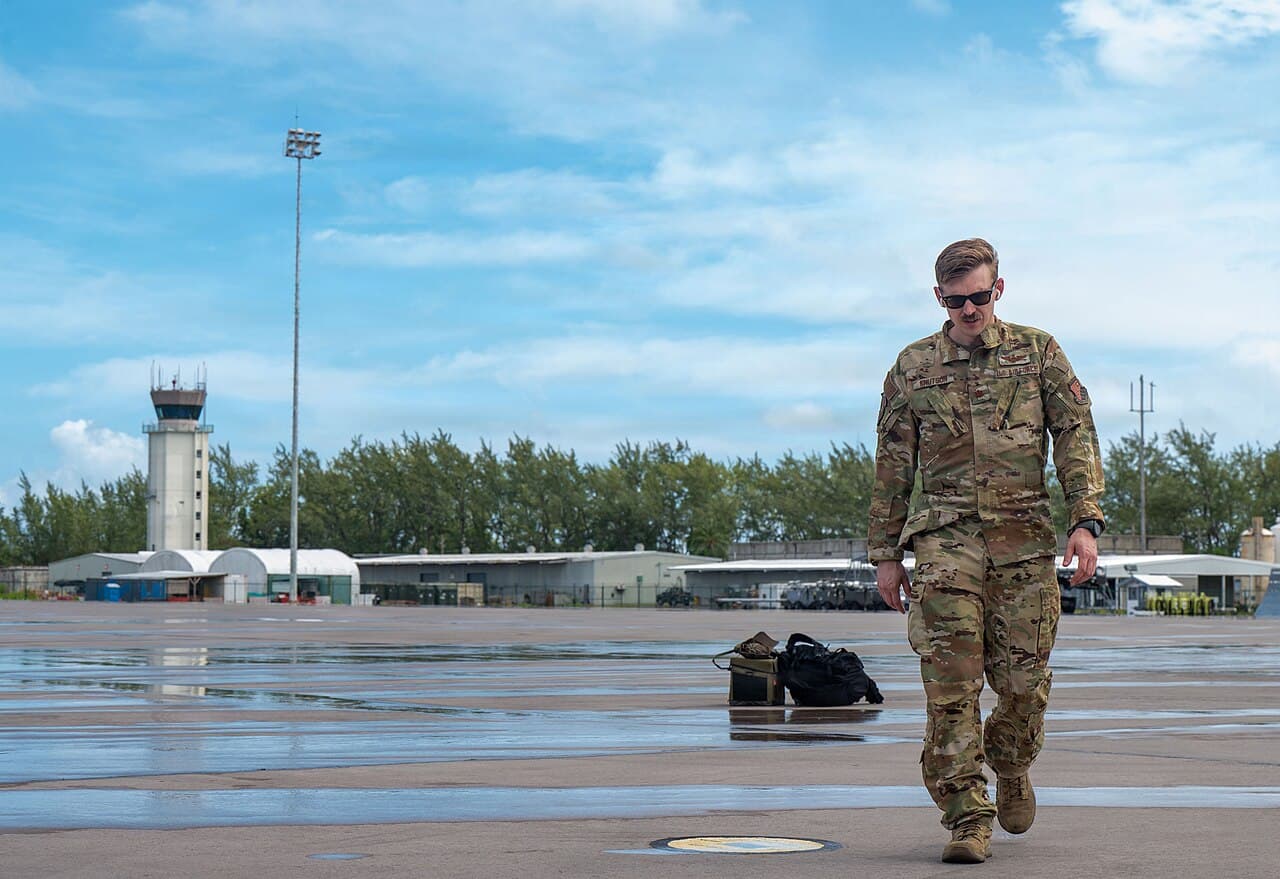
Camp Thunder Cove is a joint U.S.–U.K. operating base within Naval Support Facility Diego Garcia. It hosts U.S. service members alongside Royal Navy and Royal Air Force personnel, enabling coordinated logistics, maintenance, and forward deployment of carrier strike groups. The base supports refueling, resupply, and ammunition handling across the Indo‑Pacific.
The sovereignty transfer treaty signed on 22 May 2025 preserves the U.S. and U.K. military presence. It guarantees continued use of the installation for American and British forces, even as the Chagos Islands move toward Mauritian control.
Iran has launched two ballistic missiles toward Diego Garcia, according to reports. Tehran also warned the United Kingdom that permitting U.S. strikes from British bases would constitute aggression, a claim the UK has not independently confirmed. Unidentified drones were sighted over the atoll, though the extent of any threat remains unverified.
The U.S. Navy is relocating its primary logistics hub from Bahrain to Diego Garcia after Iranian strikes damaged a Bahraini facility. The shift aims to maintain uninterrupted supply lines for carrier groups operating in the Gulf and wider Indian Ocean.
Bertrice Pompe, born on Diego Garcia in 1971, represents the last generation of Chagossians who lived on the island before displacement. Her story underscores the human impact of the strategic realignment.
Reactions from Washington, London, and Port Louis have been mixed. U.S. officials stress the base’s irreplaceable role, while Mauritian authorities reiterate their claim to full sovereignty. The next phase will focus on sustaining operations while navigating diplomatic challenges in the Indian Ocean.
Chagossian Displacement and Bertrice Pompe's Legacy
Bertrice Pompe was born on Diego Garcia in 1971. She is among the last Chagossians to have been born on the island before the mass displacement began in the late 1960s and early 1970s. The Chagossian population was removed to make way for the U.S.-U.K. military facility, a process that has shaped decades of legal and diplomatic dispute. Pompe’s birth year anchors her story in the final wave of a community uprooted to accommodate strategic interests in the Indian Ocean. Her presence symbolizes both the human cost of the base’s establishment and the enduring claim of the displaced people. Though she left the island as a child, her life reflects the generational rupture caused by forced migration. Today, she lives in the United Kingdom, where she has become an advocate for Chagossian rights and recognition. Her testimony has appeared in parliamentary hearings and legal submissions related to the sovereignty dispute. The treaty signed on 22 May 2025 between the United Kingdom and Mauritius preserves the U.S.-U.K. military base at Diego Garcia while transferring sovereignty over the Chagos Islands. It includes a clause ensuring the continued operation of the base, despite the change in territorial administration. This arrangement has drawn criticism from Mauritian officials and legal scholars who question the legitimacy of maintaining foreign military control over territory whose sovereignty has been transferred. Yet for the United States and the United Kingdom, Diego Garcia remains indispensable to naval operations, supply chains, and power projection across the Indian Ocean and Gulf of Oman. The base supports carrier strike groups and logistics networks, especially following disruptions in Bahrain. Pompe’s legacy thus unfolds alongside a strategic calculus that continues to prioritize military access over the rights of the displaced. Her story is not just one of loss, but of persistence — a reminder that behind every geopolitical decision, there are lives uprooted and voices that refuse to be erased.
Reactions from U.S., U.K., and Mauritius
U.S. officials reaffirmed that the Diego Garcia facility remains indispensable to regional operations. A Pentagon spokesperson said the base “continues to provide critical logistics, refuelling and forward presence” for carrier strike groups and bomber deployments, citing the recent shift from Bahrain after Iranian strikes damaged a logistics hub. UK defence ministers echoed the stance, describing the installation as “a cornerstone of the joint UK‑U.S. presence in the Indo‑Pacific” and pledging “full support for its continued use.”
Mauritian representatives welcomed the sovereignty transfer as a long‑overdue act of decolonisation but stressed that the treaty’s clause preserving the military base does not alter day‑to‑day access. A foreign ministry statement noted that “the hand‑over of sovereignty does not affect the operational status of the existing installations,” and urged that the island’s future be shaped by both security and diplomatic considerations.
The re‑affirmations come as Iran has fired two ballistic missiles toward Diego Garcia and issued warnings to the UK over its cooperation with U.S. strikes. U.S. and U.K. officials said the missile launches underscore the strategic importance of the atoll while insisting that the new treaty framework provides a stable backdrop for ongoing operations. The joint statement from Washington and London concluded that “the base will remain a central element of our collective security posture” despite the broader sovereignty transition.
Next Steps in the Diego Garcia Strategic Calculus
The United States intends to retain Diego Garcia as a forward operating base in the Indian Ocean. According to reports, the Navy will keep its logistics hub there after shifting from Bahrain, where Iranian strikes damaged a key facility. U.S. officials say the island remains essential for carrier strike group support and supply chain resilience. Joint UK-US operations continue at Camp Thunder Cove, where both militaries coordinate logistics and forward presence. A May 22, 2025 treaty transferring sovereignty over the Chagos Islands to Mauritius includes a clause guaranteeing the base’s continued use by U.S. and British forces. British and American officials have emphasized that this arrangement is not subject to negotiation. Iran has launched ballistic missiles toward Diego Garcia, according to unverified reports, and issued warnings to the UK over its cooperation with U.S. strikes. An Iranian MP cautioned that allowing Western powers to use British bases for attacks would constitute aggression and justify Tehran’s right to self-defence. U.S. intelligence is monitoring these developments closely, including the movement of unidentified drones near the atoll. Pentagon planners are adjusting regional posture in response to North Korea’s potential tactical learning from Ukraine, though no specific drills with South Korea will occur this year. The base’s strategic value persists despite diplomatic shifts, with both governments affirming its operational role. Monitoring of Iranian activity remains a priority, as does the maintenance of communication channels with U.K. partners. The next phase involves sustained readiness, with an emphasis on rapid deployment and regional deterrence. No changes to the base’s legal status are expected, even as sovereignty transfers proceed. Its role as a linchpin in Indo-Pacific logistics is expected to endure.
Frequently asked questions
When was the treaty signed to transfer sovereignty of the Chagos Islands to Mauritius and what does it say about the Diego Garcia base?
The treaty was signed on 22 May 2025. It transfers sovereignty from the UK to Mauritius but includes a provision that the military base at Diego Garcia will continue to operate.
Why is Diego Garcia considered strategically important for the U.S. and U.K.?
Diego Garcia is a strategically located atoll in the central Indian Ocean that hosts a key U.S.-U.K. military facility within the British Indian Ocean Territory. It supports U.S. carrier strike groups and supply chains.
What recent military activity involving Iran has affected Diego Garcia?
Iran fired two ballistic missiles toward U.S. and U.K. military bases in Diego Garcia, according to reports. The strikes follow Iran's warning to the UK against allowing U.S. use of British bases for attacks.
How has the U.S. military presence at Diego Garcia changed recently?
The U.S. Navy is shifting its main regional logistics hub from Bahrain to Diego Garcia after Iranian strikes damaged a key American facility in Bahrain. B-2 stealth bombers have also been deployed to Diego Garcia.
What is the status of the joint UK-U.S. military base at Diego Garcia after the sovereignty transfer treaty?
Despite the treaty transferring sovereignty of the Chagos Islands to Mauritius on 22 May 2025, the treaty includes a provision ensuring the continued operation of the U.S.-U.K. military base at Diego Garcia.